
Overcoming international delivery delays

International delivery delays are one of the biggest challenges for retailers selling across borders. The risk increases during busy periods such as Black Friday, Cyber Monday and Christmas, when higher order volumes put additional pressure on warehouses, transport networks and last-mile operators.
Retailers cannot prevent every disruption. However, they can reduce the impact by identifying risks early, monitoring shipments and setting realistic expectations from checkout to delivery.
Why do international delivery delays happen?
An international shipment passes through several stages. These may include order preparation, sorting, cross-border transport, customs clearance, entry into the destination network and last-mile delivery.
A disruption at any stage can affect the final delivery time. Common causes include:
- incomplete or incorrect shipment data;
- missing or invalid customs information;
- unsuitable packaging or unreadable labels;
- limited network capacity;
- severe weather or transport disruption;
- customs procedures;
- destination-specific requirements;
- delays within a local delivery network.
During Peak Season, processes that work well under normal conditions may come under pressure. Reviewing them before volumes increase can help retailers identify weaknesses early.
Spring GDS data illustrates the scale of this seasonal pressure. Average daily parcel volumes across its European network increased by nearly 40% during the 2025 Peak Season, measured from 15 October to 31 December, compared with the rest of the year.
The visible delay is not always the real problem. The cause may have appeared much earlier in the shipping process.

Look beyond the obvious cause
When a shipment stops moving, it is easy to blame high volumes or the carrier. In practice, the problem may have started before the parcel entered the transport network.
From our experience at Spring GDS, shipment and customs data are important areas to check. Incorrect, incomplete or outdated information can interrupt the process and create avoidable delays.
For UK retailers, the correct EORI number depends on where customs activities take place. Businesses moving goods to or from Great Britain generally need an EORI number beginning with GB. They may also need an EU EORI number if they make customs declarations in the EU, for example when acting as the importer of record. Retailers using the Import One Stop Shop (IOSS) should also ensure that their IOSS details are valid and correctly recorded in the relevant systems. Checking EORI and IOSS information before dispatch can help prevent avoidable customs delays.
| EORI | IOSS |
|---|---|
| An EORI number identifies businesses and other economic operators for customs procedures. UK businesses moving goods to or from Great Britain generally need a GB EORI number and may also need an EU EORI number if they make customs declarations in the EU. | The Import One Stop Shop (IOSS) simplifies VAT declaration and payment for eligible distance sales of imported goods with a value of up to €150. |
Packaging and barcode problems can look like transport delays
Sometimes the apparent cause of a delivery delay is different from the actual operational problem.
In one case observed by Spring GDS, several parcels appeared to have been delayed in transit. An investigation showed that the packaging had not been sealed correctly. Some parcels opened while moving through the network and had to be isolated, inspected and repacked before continuing their journey.
What initially looked like a transport problem was actually a packaging issue.
In another case, a retailer used the shipping label as additional adhesive to keep parcels closed. This made the barcodes more difficult to read. The parcels then required manual handling, slowing down their journey.
Barcodes support the automatic identification and tracking of shipments throughout the supply chain. GS1 guidance also highlights that folds, damage and poor label placement can affect barcode readability.
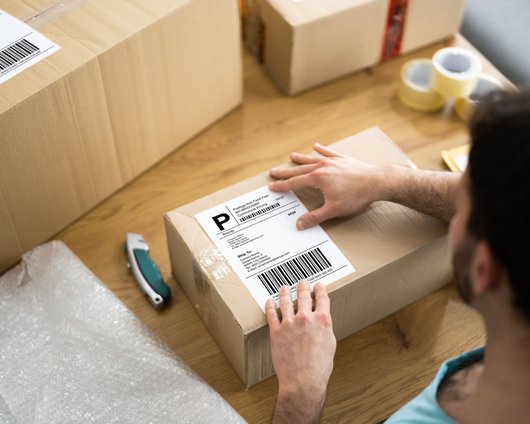
Before dispatching parcels, check that:
the packaging is suitable for the weight and contents;
the parcel is securely sealed;
the shipping label is flat and clearly visible;
the barcode is not covered, folded or placed across an edge;
old or unrelated labels have been removed;
shipment and customs data match the physical parcel.

Use tracking data to identify exceptions early
Tracking is not only a tool for consumers. It can also help retailers and logistics partners notice when a shipment is no longer following its expected route or timeframe.
Examples of possible warning signs include:
- a parcel remaining at one location longer than expected;
- an unusual tracking event;
- missing updates within the normal timeframe;
- a growing number of similar exceptions in one market.
During Peak Season, this visibility becomes especially important. Identifying a pattern early gives the retailer more time to investigate, update delivery estimates or contact affected customers.
An international delivery journey may involve several logistics networks. Tracking information can therefore combine updates from different partners and stages of the journey, giving retailers and customers a more complete view of the shipment’s progress.
Review previous campaigns to identify:
- days and periods with the highest order volumes;
- markets and routes with the longest delivery times;
- recurring tracking and shipment exceptions;
- common customs, shipment data, packaging or labelling problems;
- periods of network congestion;
- the main reasons customers contacted support.
Use these findings to decide where additional capacity, lead time, process changes or customer communication may be needed.

Provide logistics partners with information about:
- expected order volumes;
- planned campaigns;
- priority destination markets;
- product or parcel characteristics;
- expected dates of volume increases.
Early forecasts make it easier to identify capacity limitations and operational risks before they affect shipments.

Decide in advance:
- what happens if volumes exceed the forecast;
- when delivery estimates should be extended;
- which markets need additional lead time;
- who will approve changes to customer communication;
- how affected customers will be informed.

Set realistic delivery expectations
The delivery time shown at checkout should reflect current operational conditions.
Keeping the same promise throughout the year may not be realistic during periods of exceptionally high demand. An ambitious estimate may help secure a sale, but it can also lead to disappointment if the order arrives later.
Review delivery estimates by considering:
- the destination market;
- the selected delivery service;
- expected order volumes;
- available operational capacity;
- known holidays or service disruptions.
A slightly longer but achievable timeframe is often better than a faster promise that cannot be kept.
Communicate order cut-off dates clearly
Order cut-off dates are particularly important before events such as Christmas. Customers need to know when they should order if they want a reasonable expectation of receiving their purchase before a specific date.
Cut-off dates may vary by country and delivery service. Display them clearly on relevant product pages, at checkout and in campaign communication.
They should also be reviewed whenever delivery conditions change.
When planning delivery estimates, check current international service alerts and international holidays.

Not every international delivery delay can be avoided. When a problem occurs, clear communication becomes part of the solution.
Where possible, tell the customer:
- that the estimated delivery time has changed;
- what they can expect next;
- whether a new delivery estimate is available;
- where they can find updated tracking information;
- who they should contact if they need help.
Communicate proactively when a delay occurs
The information shown in tracking, on the website and by customer service should be consistent.
Customers should not have to contact several teams to understand what is happening.
Do not wait for the customer to discover the delay. If reliable information is available, communicate it proactively.
Inform customers early
Do not wait for customers to discover the delay themselves. Share an update as soon as reliable information is available.

Keep information consistent
Make sure tracking updates, website information and customer service responses communicate the same message.

Explain what happens next
Where possible, provide a new delivery estimate or a clear next step, so customers know what to expect.

Keep logistics, e-commerce and customer service aligned
International delivery delays are not only a logistics issue.
E-commerce and marketing teams need realistic delivery information before launching campaigns. Customer service teams need access to current shipment updates. Logistics partners need forecasts that help them prepare for changes in volume.
For example, if transit times begin to increase in a particular market, the retailer may need to update the delivery estimate shown at checkout before more orders are affected.
A simple response plan should define:
- who monitors shipment performance;
- who investigates recurring exceptions;
- who updates website information;
- who communicates with customers;
- when a problem should be escalated.
This turns logistics data into a practical tool for managing the customer experience.
Review performance after Peak Season
The end of Peak Season should not be the end of the analysis.
Compare the results with the issues identified before Peak Season. Check whether the actions taken reduced recurring delays, shipment exceptions, data errors and customer enquiries, and identify what should change before the next major campaign.
Conditions can vary significantly between destination markets. A process that works well in one country may need to be adjusted for another.
Use the findings to improve forecasts, delivery estimates, packaging guidelines and customer communication for the next campaign.
How can retailers reduce the impact of international delivery delays?
No single action can prevent every delay. The most effective approach combines:
- accurate shipment and customs data;
- secure packaging and readable labels;
- realistic delivery promises;
- early identification of tracking exceptions;
- close cooperation with logistics partners;
- proactive customer communication;
- regular analysis and process improvement.
During Peak Season, the goal is not simply to promise the fastest delivery. It is to make a reliable promise, monitor whether it can still be met and respond clearly when circumstances change.
FAQ
Why are international shipments delayed?
International shipments move through several operational stages and may involve more than one logistics network. Delays can result from incorrect shipment data, customs procedures, capacity constraints, severe weather, transport disruption, packaging problems or issues in the destination market.
How can retailers identify a potential delay?
Retailers can monitor tracking events, missing updates and deviations from normal transit times. Reviewing historical shipment data can also help identify routes, markets and periods with a higher risk of delays.
How can customs data affect delivery times?
Missing, incorrect or outdated customs information may interrupt customs processing. UK retailers should validate the required shipment details before parcels enter the logistics network. This includes confirming that they use the appropriate GB EORI number and, where applicable, an EU EORI number or valid IOSS details.
How should retailers manage delivery expectations during Peak Season?
Retailers should provide realistic delivery estimates, communicate country-specific order cut-off dates and update customers proactively when the expected delivery time changes.
What should a retailer communicate when an order is delayed?
The retailer should explain that the delivery estimate has changed and, where possible, provide a new expected date or clear next step. Tracking information, website updates and customer service responses should remain consistent.
How should retailers prepare for Black Friday and Christmas shipping?
Preparation should include volume forecasts, a review of previous campaigns, updated delivery estimates, coordination with logistics partners and contingency plans for unexpected increases in orders or transit times.


